

18 Nov 2026
214
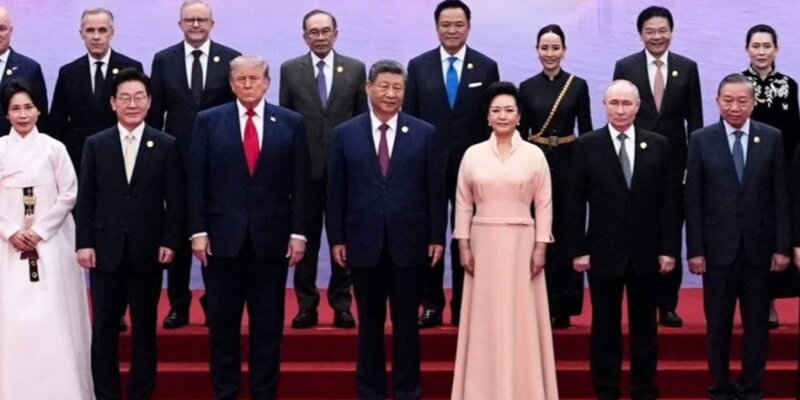
"Go to your place," is the unmistakable message conveyed on camera to Vladimir Putin, who attempts to maneuver diplomatically between the leaders of the United States and China. Visibly constrained, he assumes his designated position next to China’s First Lady, where Xi Jinping pointedly clears a spot for him...
Regardless of how Moscow and pro-Kremlin narratives attempt to frame this summit—portraying it as an imminent tripartite division of the globe and spheres of influence under a nascent "multipolar world order"—the underlying geopolitical reality is profoundly concerning for Russia. No spheres of influence are being partitioned in China. Rather, the United States and China are seeking to establish guardrails and rules of engagement for their intensifying strategic competition across all domains—air, sea, land, and space. Russia is present not as an equal arbiter, but as a geopolitical pawn—granted merely the discretion to choose which superpower’s interests it will ultimately serve and be sacrificed for. The agenda is dictated exclusively by Washington and Beijing, and its objective is not territorial or geopolitical division, but the regulation of bilateral competition without mutually imposed outcomes.
Donald Trump still harbors expectations that, amid the deadlock over a Ukrainian settlement—whose ultimate strategic objective is not merely resolving European security, but containing China, a struggle in which Trump seeks to align Moscow with Washington—Putin will eventually pivot toward the United States. However, Putin remains unprepared for such a strategic realignment. Clinging to geopolitical illusions, he attempts to project great-power ambitions with limited resources, striving to stand on equal footing with two superpowers that genuinely meet the political, economic, technological, and military criteria of global poles.
The airport protocol footage of the Chinese President welcoming his American counterpart underscores that Beijing remains acutely sensitive to its relationship with Washington. China recognizes that its current economic and technological ascent was largely facilitated by access to the US market and innovation ecosystem, and that critical structural dependencies persist. Conversely, the US President, guided by a transactional, business-oriented approach, is in no haste to escalate into open confrontation with China, opting instead to explore diplomatic off-ramps.
Thus, while Ukraine and Europe are absent from the summit in China and Russia is at the table, it is, paradoxically, Russia’s own geopolitical fate that hangs most precariously in the balance.
As an Armenian proverb aptly observes, "He who digs a pit for others falls into it himself." For centuries, and particularly over the past two decades, Russia routinely treated Armenia as a expendable bargaining chip in its geopolitical dealings with Turkey. In the words of the English idiom, what goes around comes around—or, more bluntly, karma is a bitch.