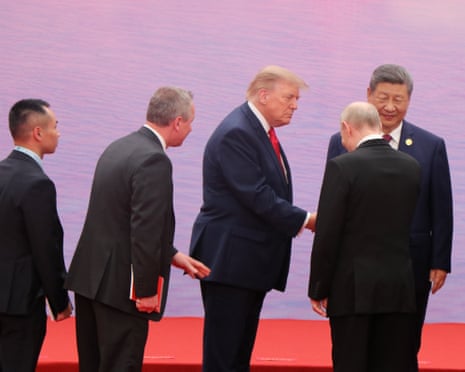

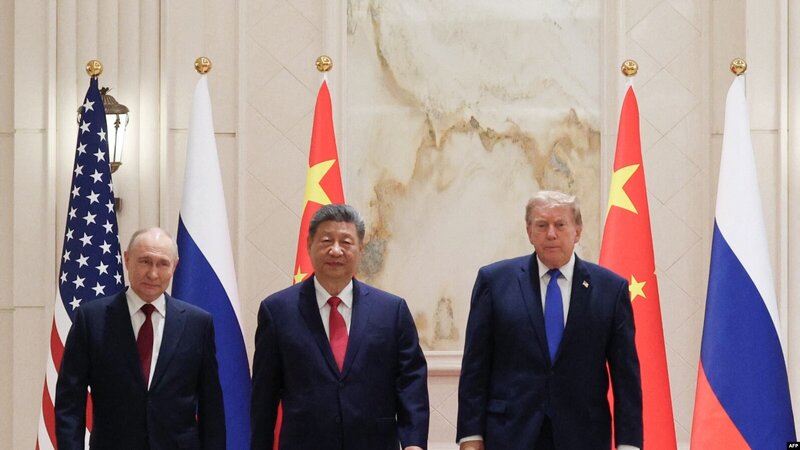
No matter how hard Russia’s pro-Kremlin propagandists, pundits, and their foreign imitators tried—and continue to try—to portray the trilateral meeting of the Presidents of the United States, China, and Russia on the sidelines of the APEC Summit in Shenzhen as "Yalta 2.0"—meaning the establishment and legitimation of a tripolar world order and the division of spheres of influence—there was not even a hint of this in what actually transpired.
The United States did not even format or institutionalize the conflicts in Iran and Ukraine on an international or global level in a way that would allow China and Russia to become regular international parties to their discussion.
The European Union, which had been concerned about the absence of both itself and Ukraine at the negotiating table, can breathe a sigh of relief. Russia’s presence at the table does not elevate it beyond its status as an object and a direct party to the conflict, while the agenda consisted exclusively of issues aimed at preventing deviations in its future behavior.
90 Minutes in Shenzhen: The Major League Dream vs. the "Junior Partner" Reality — The "Black Briefcase" Didn't Help
"Yalta 2.0" did not happen and could not have happened, as I wrote in my column yesterday. It would belong to the realm of fantasy to imagine and believe that during a meeting lasting 1.5 hours, it was technically possible to "divide" the world and spheres of influence. At least the United States had neither the interest nor the necessity to do so, even if China and Russia did.
Nevertheless, the Russian President’s delegation demonstratively arrived in Shenzhen with the "nuclear briefcase," attempting to remind its counterparts once again that Russia is a nuclear power and deserves to play in the "Major League." Even Vladimir Putin’s speech in a half-empty hall, as reported by international media, served as an economic justification for this: he claimed that in recent years Russia has already surpassed Europe in terms of GDP, welfare, and other indicators, and therefore, by virtue of its nuclear weapons, economic might, and importance in global affairs, deserves to be in that top league and be recognized as one of the poles of a multipolar world order. Those present might have believed in Russia’s status as a nuclear power—evidenced by the "black briefcase" accompanying Putin—but they could not believe the economic figures he cited: the hall was not only half-empty, there were no naive people in it either…
Instead, a 4-point agreement-declaration was reached, which will serve as a straitjacket for Putin and Xi Jinping regarding stepping outside the fixed trilateral arrangements or adopting alternative behaviors and decisions during escalations of conflict.
A 4-Point Straitjacket Instead of Dividing the World: Reading Between the Lines of the Shenzhen Summit
Let us quote the joint declaration posted on the White House website in full:

"Donald J. Trump, President of the United States of America, Vladimir Putin, President of the Russian Federation, and Xi Jinping, State Chairman of the People’s Republic of China, met in Shenzhen on November 19, 2026. The U.S. and Russian heads of state expressed appreciation to China for hosting this historic trilateral Summit. The three heads of state had an in-depth exchange of views on the current international situation and committed to maintaining strategic stability and international security.
1․ As permanent members of the United Nations Security Council, the United States, Russia, and China committed to reform the UN so that the UN can respond more effectively to global challenges and conform to its fundamental mission of international peace and security.
2․ The three countries plan to increase the production and supply of refined petroleum products for the benefit of all nations. They reaffirmed the importance of stable energy flows.
3․ The three heads of state recognized that the principle of state consent and respect for immunities of State officials are of paramount importance, and concurred that the International Criminal Court and other similar bodies must not abuse their jurisdiction.
4․ The three heads of state reaffirmed that a nuclear war cannot be won and must never be fought. The three countries will conduct a dialogue on reducing nuclear risks and preventing the proliferation of nuclear weapons."
From these 4 points, it is entirely obvious what concerns the United States: the decision-making deadlock at the UN, where both China and Russia successfully block resolutions using their veto mechanism. The U.S. is opening a window for UN reform, securing the commitment of the other parties in return, especially since demands for reform are now being voiced by many other visible, influential, and ambitious states across various continents on the global chessboard.
Trump’s "Generosity" and Beijing’s Cold Shower: What Happened Behind Closed Doors
In exchange, of course, the U.S. provides security guarantees and assumes a commitment toward Putin—who has been intimidated by International Criminal Court prosecutions and confined to the Kremlin—meaning that when it comes to enforcing the Court's rulings, the U.S. will not allow his arrest. This is no concession for the U.S., considering the heated dispute between Trump and the International Criminal Court within the United States itself in recent years.
The current U.S. administration is most concerned about the instability and crisis in energy resources and their supply chains, triggered by the war against Iran and the situation in the Strait of Hormuz. It is crucial for the U.S. that China and Russia do not exploit these opportunities in the event of developments harmful to American interests.
Russia itself faces severe problems with oil refineries and supplies, which were effectively targeted this year by the Armed Forces of Ukraine, triggering a deep domestic crisis in oil-rich Russia. Consequently, beyond addressing its own vulnerabilities, the U.S. secures China’s commitment to "reaffirm the importance of stable energy flows."
Finally, the potential use of nuclear weapons (even of a tactical nature) in the Ukrainian theater has become a major concern for the U.S.—a threat created more than once by Russian aggression, and particularly this year due to the escalating intensity of the Russo-Ukrainian war.
The Trump administration in the U.S. is worried not only that China is profitably exploiting the Ukrainian and Iranian crises, but also that in the event of nuclear weapons use, the U.S., as NATO’s leading state and primary guarantor, would be forced to become a direct party to such a war. These concerns also lie between the lines of his attacks directed at NATO and the leader of Ukraine; therefore, these risks must be managed so that Putin never reaches for the "nuclear briefcase" and China finds no justification for such a move.
However, the other edge of the sharp "nuclear blade" is Iran’s nuclear program. To halt it, the United States joined Israel’s offensive against Iran, and the war escalated into a U.S.–Iranian conflict with well-known consequences: Iran’s program has not been stopped, and the Strait of Hormuz is closed, severing global supply chains—and especially the stable flow of energy resources—triggering a fuel crisis in the United States as well. Therefore, it is crucial for the U.S. that during its subsequent actions, whether diplomatic-negotiating or military, China and Russia do not provide an "emergency exit" for Iran, exercise restraint, and refrain from legitimizing its moves to acquire or use nuclear weapons.
Thus, one of the most important provisions of the trilateral declaration for the U.S. is precisely the final point, in which the three countries reaffirm that there are no winners in a nuclear war and commit to conducting dialogue on reducing nuclear risks.
A Trilateral Meeting Without Dividing the World: Who Gained What in Shenzhen?
Undoubtedly, the U.S. will also transfer this commitment into the text of the upcoming G20 declaration to be held on its own soil. To prevent this from becoming problematic, Trump used the APEC Summit in Shenzhen to secure the advance commitment of these two troublesome states; resolving the remaining issues on the spot will be much easier for Washington. In return, for the Russian President’s participation in this summit, the U.S. administration resolved the issue of non-arrest under the International Criminal Court warrant (an obstacle Putin had faced for several years, preventing him from personally attending summits in countries such as South Africa and India), partially lifting him out of international isolation while simultaneously placing him in serious dependence on Washington. Most ironically of all, Trump sold his own domestic conflict with the International Criminal Court to Putin as an act of generosity.
Trump is entirely satisfied with the results achieved. Putin is irritated, realizing that the maximum objective for which he traveled to Shenzhen was not attained. He had deeply coveted that in this Chinese city, Trump would create a new international format on Ukraine and Europe without Kyiv and Brussels at the table.
That did not happen because the U.S. has no such goal. Putin had cherished the hope that the Shenzhen meeting would become a kind of "Yalta 2.0" in terms of obtaining Chinese and American "recognition" of his spheres of influence, but to no avail: China and the U.S. have no interest or intention of recognizing such zones. Moreover, the republics of the Caucasus and Central Asia—Armenia, Azerbaijan, Kazakhstan and Uzbekistan, viewed as Russia’s "traditional spheres of influence"—have already been invited to the upcoming G20 Summit in the United States. Geoeconomic communication projects and supply chains of both the U.S. and China pass and will continue to pass through these countries, where neither Beijing nor Washington has any plans or intentions to grant Russia a dominant role.
Shenzhen Is Not Yalta: Why the Division of the World Failed and What Putin Got
This, of course, does not mean that Russia has been deprived of room to maneuver in the strategic rivalry between the two superpowers. It will have that window. However, the rules of the game are such that Moscow will be forced to serve one side or the other—strengthening that side, paying the price personally, and still failing to get what it desires.
Putin’s nervous demeanor was driven not so much by the attitude of the United States, which was predictable, as by the stance of China. While Putin knew beforehand that the West and the U.S. reject his ambitions to be a superpower and a global pole (the very reason he launched the aggression against Ukraine), his primary disappointment was linked to Beijing: he believed China would treat him as an equal partner. Yet at every turn—from the airport welcome, the group photo, and the seating arrangement at dinner to the escalator protocol—Trump and Xi Jinping made it clear to him that he is, at best, a junior partner, not a major-league player.
Therefore, Putin knows better than anyone that Shenzhen is not Yalta, and as the adventurous swindler character in a famous Soviet film would say: "No, Shura, this is not Rio de Janeiro…"